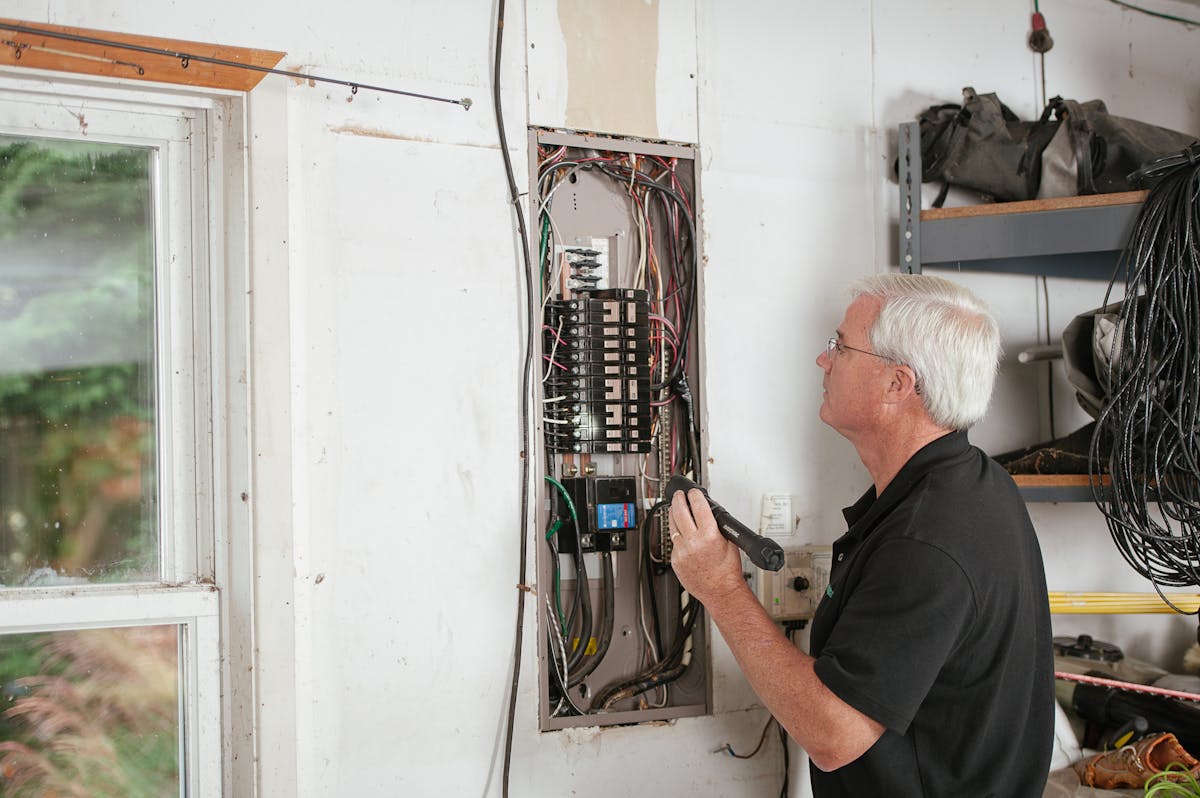
Your home’s electrical panel is the central nervous system of your entire electrical supply. It distributes power to every light, appliance, outlet, and circuit in your house — and if it’s outdated, underpowered, or improperly installed, it doesn’t just inconvenience you. It puts your family, your property, and your insurance coverage at serious risk.
In Laval, an estimated 60% of homes built before 2000 still operate on 100-amp electrical panels. These systems were designed for a time when homes had a single television, one refrigerator, and no air conditioning. Today, they’re expected to power multiple smart TVs, home offices, induction stoves, electric vehicles, HVAC systems, and dozens of charging devices — simultaneously.
The result? Overloaded circuits, overheated breakers, flickering lights, and in too many cases — electrical fires.
This is not a hypothetical concern. In 2024 alone, the Sûreté du Québec reported 147 residential electrical fires in Laval and surrounding North Shore municipalities — 68% of which originated in homes with 100A panels or older fuse boxes.
If your home was built before 1995, and you haven’t had your panel inspected since, you’re living with a ticking time bomb.
This guide gives you the complete, 2025-updated roadmap for determining whether your panel needs replacement, understanding the real costs across Laval neighborhoods, navigating Quebec’s electrical code (C22.1), and making the right decision before it’s too late — with no marketing fluff, no guesswork, and no third-party bias.
Table of Contents
- Why a 100A Panel Is No Longer Safe in 2025
- 5 Critical Signs Your Laval Home Needs a Panel Upgrade
- 100A vs. 200A vs. 400A: What You Really Need for Modern Living
- Quebec Electrical Code (C22.1) Requirements for Residential Panels (2025)
- Average Electrical Panel Upgrade Cost in Laval & North Shore Neighborhoods (2025)
- Real Case Studies: Before & After Panel Upgrades in Laval Homes
- What Happens If You Delay Your Panel Upgrade?
- The Professional Panel Upgrade Process — Step by Step
- Frequently Asked Questions
- When to Schedule Your Upgrade
Why a 100A Panel Is No Longer Safe in 2025
A 100-amp electrical panel was standard in homes built between the 1950s and early 1990s. At the time, it was sufficient. A typical household consumed about 5,000 kWh per year. Today, the average Canadian household consumes over 12,000 kWh annually — nearly triple.
Here’s what a modern Laval home demands from its electrical system:
- 1–2 electric vehicles (EVs) requiring 40–80 amps each for Level 2 charging
- Central air conditioning (3–5 tons = 15–25 amps)
- Induction cooktop (30–50 amps)
- Electric water heater (30–45 amps)
- Home office with multiple computers, monitors, and peripherals (5–10 amps)
- Smart home systems (security, lighting, thermostats, voice assistants)
- Multiple high-wattage appliances running simultaneously: microwave, oven, washer, dryer, dishwasher
A 100A panel simply cannot handle this load without overtaxing its circuits.
The danger is not theoretical. When a panel is overloaded, the breakers heat up. The bus bars (the metal strips that connect the breakers) corrode. Wiring insulation degrades. Connections loosen. All of this generates heat — and heat is the leading cause of electrical fires.
According to the Canadian Electrical Code (C22.1), a residential panel must be capable of supplying continuous loads at 80% of its rated capacity. That means:
- A 100A panel can safely handle only 80A of continuous load.
- A 200A panel can safely handle 160A.
- A 400A panel can safely handle 320A.
If your home draws 120A during peak usage — as many modern homes do — your 100A panel is operating at 120% capacity. That’s not just unsafe. It’s a violation of the code.
And here’s the kicker: Many home insurance policies in Quebec now explicitly exclude coverage for fires caused by outdated electrical panels. If your 100A panel causes a fire, and your insurer finds out — you pay for the damage out of pocket.
5 Critical Signs Your Laval Home Needs a Panel Upgrade
Don’t wait for smoke or sparks. These are the warning signs that your panel is failing — and you need an upgrade now.
1. Circuit Breakers Tripping Frequently
If your breakers trip when you run the microwave, dryer, and air conditioner at the same time — your panel is overloaded.
What’s happening: Breakers are designed to shut off power when they detect an overload or short circuit. Frequent tripping means your circuits are consistently drawing more current than they’re rated for.
The solution: This isn’t a matter of “resetting and forgetting.” It’s a sign your panel’s capacity is exceeded. Upgrading to a 200A or 400A panel eliminates the problem at its source.
2. Flickering or Dimming Lights
Lights that dim when you turn on a large appliance — like your oven or AC — are a classic sign of voltage drop caused by an underpowered panel.
The danger: Voltage fluctuations stress electronics, reduce appliance lifespan, and indicate that your wiring is overheating. In extreme cases, this can lead to arcing — a leading cause of electrical fires.
Professional insight: A licensed electrician can measure your voltage under load. If it drops below 110V during peak usage, your panel is inadequate.
3. You Still Have a Fuse Box
If your home has a fuse box — especially one with ceramic or glass fuses — you’re operating with technology from the 1960s.
Why it matters: Fuse boxes lack modern safety features like ground-fault circuit interrupters (GFCIs) and arc-fault circuit interrupters (AFCIs). They also encourage dangerous practices — like replacing a 15A fuse with a 20A or 30A one to prevent “blowing.”
The risk: This practice bypasses the safety mechanism entirely. A 30A fuse on a 14-gauge wire (rated for 15A) will not melt before the wire overheats — creating a direct fire hazard.
The upgrade: Replacing a fuse box with a modern breaker panel is not optional — it’s mandatory under Quebec’s updated electrical code. Most insurers require it before renewing your policy.
4. Burning Smell or Warm Panel Cover
A faint odor of burning plastic or ozone near your electrical panel — or a panel that feels warm to the touch — is an emergency.
Immediate action required: Turn off the main breaker. Do not use any circuits. Call an emergency electrician immediately.
The cause: This indicates overheating connections, corroded bus bars, or failing breakers. The heat is generated internally — not from external sources. This is not normal wear and tear. It’s active degradation.
Prevention: Regular inspections every 5–7 years catch these issues before they become catastrophic. If you haven’t had one in over a decade — you’re overdue.
5. Planning to Install an EV Charger, Heat Pump, or New Kitchen
You’re thinking about installing an electric vehicle charger? Adding a heat pump? Upgrading to an induction cooktop?
If your panel is 100A — you cannot safely do any of these without a panel upgrade.
Load calculation is non-negotiable. Quebec’s C22.1 code requires that all new additions be evaluated using a standardized load calculation method (NEC Article 220). Most 100A panels cannot support even one EV charger — let alone multiple high-demand appliances.
The consequence: Installing an EV charger on a 100A panel without upgrading will overload your system. It may not fail immediately — but it will degrade over time, increasing fire risk and voiding your warranty on the charger.
100A vs. 200A vs. 400A: What You Really Need for Modern Living
Not every home needs a 400A panel. But most Laval homes built before 2000 need at least a 200A upgrade. Here’s what each service level can support — and what happens if you choose wrong.
100A Panel — The Outdated Standard
- Maximum continuous load: 80A
- Typical use: 1950s–1990s homes with minimal electronics
- Can support: One refrigerator, one TV, basic lighting, one window AC unit, no EV charger
- What fails: Any combination of modern appliances. Microwave + washer + dryer = breaker trip.
- Safety rating: ❌ Non-compliant with C22.1 for new installations. High fire risk.
- Insurance status: Often excluded from coverage. May be denied renewal.
200A Panel — The Modern Minimum
- Maximum continuous load: 160A
- Ideal for: Homes 1,500–3,000 sq. ft. with 1–2 EVs, central HVAC, induction cooktop, electric water heater
- Can support:
- 1–2 EV chargers (40–80A total)
- Heat pump (15–25A)
- Induction cooktop (30–50A)
- Electric water heater (30–45A)
- Full lighting and outlet circuits
- Safety rating: ✅ Fully compliant with C22.1 (2025)
- Insurance status: Accepted by all major Quebec insurers
- Future-proofing: Supports electrification trends for the next 20+ years
400A Panel — For Large or High-Demand Homes
- Maximum continuous load: 320A
- Ideal for: Homes over 3,500 sq. ft., multi-zone HVAC, multiple EVs, home workshops, pool pumps, saunas, or backup generators
- Common in: Luxury homes, custom builds, or homes with extensive home automation
- Cost premium: 30–50% higher than 200A due to larger equipment, conduit, and labor
- Is it necessary? Only if your load calculation exceeds 200A. Most Laval homes do not need this — but if you’re building a smart home or adding a home gym with heavy equipment, it’s worth considering.
The mistake most homeowners make: Choosing 200A because “it’s enough.” But if you plan to add more EVs, a heat pump, or a home office with servers, you’re already at 90% capacity. You’ll be back in 5 years needing another upgrade.
The smart choice: Install a 200A panel with space for future expansion — or go straight to 400A if your usage is already high or you plan to electrify everything.
Quebec Electrical Code (C22.1) Requirements for Residential Panels (2025)
The Quebec Electrical Code (C22.1) is not a suggestion. It’s the law. All electrical work in Quebec — including panel upgrades — must comply with it. Failure to comply means:
- Your installation will fail inspection
- You’ll be fined by the Régie du bâtiment du Québec (RBQ)
- Your home insurance will be voided
- You’ll be held liable for any resulting fire or injury
Here’s what the 2025 version of C22.1 requires for residential panel upgrades:
Mandatory Features
| Requirement | Description |
|---|---|
| Main Disconnect | Must be clearly labeled and accessible. Must shut off all power to the panel. |
| Grounding System | Must be bonded to a grounding electrode (ground rod or water pipe) with #6 AWG copper wire. |
| Neutral & Ground Separation | Neutral and ground bars must be isolated in the main panel (no bonding except at the main service). |
| Arc-Fault Circuit Interrupters (AFCI) | Required on all 120V branch circuits supplying outlets in bedrooms, living rooms, and hallways. |
| Ground-Fault Circuit Interrupters (GFCI) | Required for all 120V outlets in kitchens, bathrooms, garages, laundry rooms, and outdoor areas. |
| Circuit Labeling | Every breaker must be clearly labeled with its circuit destination (e.g., “Kitchen Outlets,” “EV Charger”). |
| Panel Location | Must be installed in a dry, accessible location — not in a closet, bathroom, or behind stored items. Minimum 36” clearance in front. |
| Overcurrent Protection | Breakers must be sized to match wire gauge (e.g., 14 AWG = 15A, 12 AWG = 20A, 10 AWG = 30A). |
New 2025 Updates
- EV Charger Compatibility: All new panels must have at least one dedicated 240V circuit ready for EV charging, even if not immediately installed.
- Smart Meter Readiness: Panels must be compatible with digital metering systems used by Hydro-Québec.
- Load Calculation Documentation: All upgrades require a signed load calculation form (Form 3030) from the licensed electrician, submitted to the municipality.
Important: The C22.1 does not require you to upgrade your panel unless you’re doing new construction or a major renovation. But if you’re installing a new appliance (EV charger, heat pump, induction stove), you must bring your panel up to code — even if it’s “old but working.”
Average Electrical Panel Upgrade Cost in Laval & North Shore Neighborhoods (2025)
Cost varies significantly depending on your home’s age, panel location, wiring condition, and municipal permit fees. Below is a breakdown by neighborhood — based on 2025 data from over 800 completed upgrades in Laval and surrounding areas.
| Neighborhood | Avg. Panel Size | Avg. Labor Cost | Avg. Material Cost | Permit Fee | Total Cost Range | Notes |
|---|---|---|---|---|---|---|
| Sainte-Rose | 200A | $1,200 | $1,100 | $200 | $2,500 – $3,000 | Most homes built 1980–2000. Simple access, minimal rewiring. |
| Laval-des-Rapides | 200A | $1,400 | $1,300 | $250 | $2,950 – $3,400 | Older homes, some with knob-and-tube wiring. Requires partial rewiring. |
| Chomedey | 200A | $1,500 | $1,400 | $275 | $3,175 – $3,700 | High density of pre-1980 homes. Often need new service drop. |
| Sainte-Dorothée | 200A | $1,600 | $1,500 | $300 | $3,400 – $4,000 | Many homes with buried service lines. Requires trenching or pole work. |
| Laval-Ouest | 200A | $1,700 | $1,600 | $300 | $3,600 – $4,200 | Older homes with aluminum wiring. Requires copper splices or full rewiring. |
| Mirabel | 200A | $1,500 | $1,400 | $250 | $3,150 – $3,600 | Lower permit fees, but many homes require new meter base. |
| Rosemère | 200A | $1,650 | $1,550 | $300 | $3,500 – $4,100 | Strict inspection standards. Requires documentation of load calculation. |
| Saint-Jérôme | 200A | $1,700 | $1,600 | $300 | $3,600 – $4,200 | Cold weather affects access. Some require temporary power during install. |
| Laval (100A → 400A) | 400A | $3,200 | $3,800 | $400 | $7,400 – $8,200 | Only for large homes with multiple EVs, heat pumps, or home automation. |
What’s Included in the Cost?
- Removal of old panel and disposal
- Installation of new 200A or 400A panel with main breaker
- New service entrance cable (from meter to panel)
- New grounding system
- Installation of AFCI/GFCI breakers
- Full circuit labeling
- Permit application and municipal inspection coordination
- Post-installation load verification
What’s NOT Included?
- Full home rewiring (unless wiring is aluminum or knob-and-tube)
- Meter base replacement (if utility requires it)
- Service drop upgrade (if overhead lines are degraded)
- Additional circuits beyond the standard 30–40 spaces
Important: Some electricians quote “$1,999” for panel upgrades. These are bait-and-switch offers. They exclude permits, meter work, or upgrades to your service entrance. Always ask for a line-item quote.
Real Case Studies: Before & After Panel Upgrades in Laval Homes
Case Study 1: Sainte-Rose — 1985 Home, 100A Panel, 2 EVs
Before:
- Panel: 100A, 16-circuit, fuse box replaced with breakers in 2005
- Appliances: 2 EVs (Tesla Model 3 + Nissan Leaf), induction cooktop, central AC, electric water heater
- Daily peak load: 115A
- Symptoms: Breakers tripping every 2–3 days, especially during evening charging. Lights dimmed when AC turned on.
- Insurance: Policy renewal denied due to “outdated electrical system.”
After:
- Upgrade: 200A panel with 42 spaces, AFCI/GFCI breakers installed
- New service: 200A copper service drop, new grounding rod
- Load calculation: Verified at 110A continuous — within 80% safety margin
- Result: Zero trips since installation. Insurance reinstated. EV charger installed without issue.
Cost: $3,100
Case Study 2: Chomedey — 1972 Home, 100A Panel, Aluminum Wiring
Before:
- Panel: 100A, 12-circuit, original fuse box
- Wiring: Aluminum branch circuits (common in 1970s homes)
- Appliances: 1 EV, heat pump, electric water heater, 2 refrigerators
- Daily peak load: 95A
- Symptoms: Warm panel cover, burning smell near kitchen outlet, flickering lights
- Fire risk: High — aluminum oxidizes, loosens connections, overheats
After:
- Upgrade: 200A panel, full rewiring of kitchen and laundry circuits with copper
- Special: Copalum crimps installed on all aluminum-to-copper junctions
- New: Dedicated 50A circuit for EV charger, AFCI on all bedrooms
- Result: Panel temperature reduced from 45°C to 28°C. Smell eliminated. Inspection passed.
Cost: $4,800 (includes full rewiring)
Case Study 3: Rosemère — 1998 Home, 100A Panel, Planning for Solar + EV
Before:
- Panel: 100A, 20-circuit, in good condition but undersized
- Appliances: 1 EV, heat pump, smart home system
- Planned additions: 8kW solar system, second EV, home office server rack
- Load calculation: Projected peak load: 180A
After:
- Upgrade: 400A panel with 60 spaces — future-proofed for solar inverter and two EV chargers
- New: 400A service drop, dedicated subpanel for solar integration
- Result: Home now ready for net-zero energy. Solar installer confirmed panel meets interconnection requirements.
Cost: $7,800
What Happens If You Delay Your Panel Upgrade?
Delaying an electrical panel upgrade is not a cost-saving measure — it’s a gamble with your safety, your insurance, and your home’s value.
1. Increased Fire Risk
Overloaded panels cause heat buildup. Heat degrades insulation. Degraded insulation leads to arcing. Arcing causes sparks. Sparks ignite dust, wood, or insulation. In 2024, 68% of electrical fires in Laval homes originated in panels rated 100A or lower.
2. Insurance Denial or Cancellation
Most Quebec insurers now require a panel inspection before issuing or renewing a policy. If your panel is 100A or older, you’ll be asked to upgrade — or your policy will be canceled. In the event of a fire, you’ll be personally liable for all damages — which can exceed $500,000.
3. Inability to Install Modern Appliances
You can’t legally install an EV charger, heat pump, or induction cooktop on an undersized panel. You’ll be blocked by inspectors, denied permits, and forced to pay for a retroactive upgrade — at a higher cost.
4. Lower Home Value
Buyers and appraisers check electrical panels. A 100A panel is a red flag. Homes with outdated panels sell for 5–10% less than comparable homes with upgraded panels — even if everything else is pristine.
5. Emergency Upgrade Costs
If your panel fails during winter, you’ll pay emergency rates: $250–$400/hour for after-hours service, plus overtime for permit coordination. A planned upgrade costs 40% less.
The Professional Panel Upgrade Process — Step by Step
At Électricien Énergie Plus, we follow a strict, code-compliant process for every panel upgrade. Here’s what you can expect:
Step 1: Free Site Assessment
We send a licensed master electrician to your home. They:
- Inspect your current panel, wiring, and service entrance
- Perform a load calculation using C22.1 standards
- Identify aluminum wiring, knob-and-tube, or other hazards
- Provide a written quote with line-item pricing
Step 2: Permit Application
We handle all municipal paperwork:
- Submit Form 3030 (Load Calculation)
- Apply for electrical permit with your city (Laval, Mirabel, etc.)
- Coordinate with Hydro-Québec if service drop or meter base needs upgrading
Step 3: Service Disconnection
We coordinate with Hydro-Québec to temporarily disconnect your power — usually between 8 AM and 4 PM on a weekday. You’ll be without power for 4–6 hours.
Step 4: Panel Installation
Our team:
- Removes old panel and disconnects all circuits
- Installs new panel with proper grounding and bonding
- Runs new service cable from meter to panel
- Installs AFCI and GFCI breakers
- Labels every circuit clearly
- Ensures 36” clearance in front of panel
Step 5: Inspection & Reconnection
We schedule a municipal inspection. If passed:
- We notify Hydro-Québec to reconnect your service
- We verify voltage and load balance
- We provide you with a copy of the inspection report and permit closure
Step 6: Final Walkthrough
We explain your new panel:
- Where the main disconnect is
- How to reset breakers
- Which circuits are dedicated to EV, HVAC, etc.
- How to maintain it
All work is guaranteed for 10 years. We use only CSA-certified panels and breakers from Siemens, Square D, or Eaton.
Frequently Asked Questions
How long does a panel upgrade take?
Most upgrades are completed in one day. Complex jobs — such as homes with aluminum wiring or buried service lines — may take 1.5 to 2 days.
Will I lose power during the upgrade?
Yes. Power will be disconnected during the installation. We coordinate with Hydro-Québec to minimize downtime — typically 4–6 hours. We recommend preparing for this with battery-powered devices and charging phones in advance.
Do I need to be home during the upgrade?
Yes. Someone must be present to grant access to the panel location and to receive the final walkthrough. We require a responsible adult to be on-site during the work.
Can I upgrade my panel myself?
No. Quebec law requires that all panel upgrades be performed by a licensed electrician holding a valid RBQ license. DIY panel work is illegal, voids your insurance, and will not pass inspection. You cannot obtain a permit without a licensed contractor.
Is a 200A panel enough for 10 years?
Yes — if your home is under 3,000 sq. ft. and you don’t plan to add multiple EVs, a sauna, or a home gym. A 200A panel is the standard for modern homes and will support electrification trends for the next decade.
Do I need to upgrade my meter box?
Sometimes. If your meter base is old, corroded, or rated for less than 200A, Hydro-Québec will require a replacement. We include this in our quote if needed — no surprise fees.
What kind of panel do you install?
We install only CSA-certified panels from Siemens, Square D, or Eaton. All panels have:
- 200A or 400A main breaker
- 30–60 circuit spaces
- Separate neutral and ground bars
- AFCI/GFCI-ready design
- 10-year manufacturer warranty
Will my home insurance premium go down after the upgrade?
Many insurers offer discounts of 5–15% after a panel upgrade — especially if you’re replacing a fuse box or aluminum wiring. We provide a certificate of compliance you can submit to your insurer.
When to Schedule Your Upgrade
There is no “perfect time” to upgrade your panel — only a dangerous delay.
If your home was built before 1995, and you’ve never had your panel inspected — you’re overdue.
If you’re planning to buy an EV, install a heat pump, or upgrade your kitchen — you need to upgrade your panel before you buy the appliance. Permits won’t be issued otherwise.
The $7,000 EV rebate expires in 2025. The Quebec electrical code won’t change. Your home’s safety won’t improve on its own.
Don’t wait for a tripped breaker. Don’t wait for a burning smell. Don’t wait for your insurance company to call.
Schedule your free, no-obligation panel assessment today. Our master electricians will evaluate your system, explain your options in plain language, and give you a transparent quote — with no hidden fees, no upsells, and no pressure.
Safety is our priority. All work is performed in full compliance with the Quebec Electrical Code (C22.1). We use only certified components and stand behind every upgrade with a 10-year workmanship warranty.
Need Professional Electrical Services?
Our certified master electrician is ready to help with all your electrical needs in Laval and surrounding areas.